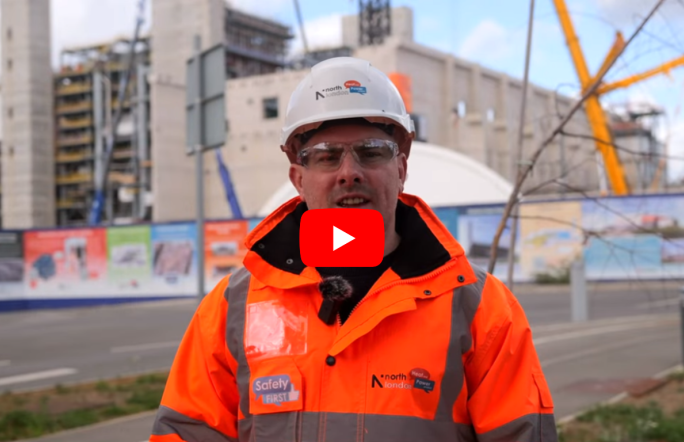
NLWA agrees to amend contract to complete Energy Recovery Facility
North London Waste Authority (NLWA) agreed today to revised terms to complete the publicly owned Energy Recovery Facility (ERF) at Edmonton EcoPark.
NLWA is a public body governed by 14 elected representatives from seven north London boroughs and all decisions are made by NLWA Members.
The ERF is now at an advanced stage and £700m has already been spent. Under the new agreement, there will be a revised contract price of £1.25bn and a completion date of December 2029, with Acciona agreeing to take on more risk which was previously held by NLWA.
Once the facility is finished, the cost per north London resident will be about £1.50 per week, which covers the collection and disposal of rubbish and recycling and access to eight Reuse and Recycling Centres. It also funds other initiatives including an extensive education programme and at least £250,000 in grants a year for community led projects to reduce waste, increase reuse and recycling and encourage innovation.
The boroughs would have faced an additional £100m a year by 2030/31 if the ERF had been cancelled. This would have included repayments on existing loans, as well as paying private operators to either incinerate or landfill north London's waste elsewhere. It would also have required around 30,000 additional lorry journeys each year to transport rubbish to those sites.
Cllr Jacob Cable, NLWA Chair, said: “Local councils are burdened with the statutory responsibility to dispose of vast volumes of rubbish, fuelled by short-lived, chuck-away products, the manufacture and distribution of which are causing great harm to the health of our planet.
"NLWA Members have closely examined the incinerator project. It's now over 60% complete and alternatives to deal with the rubbish of two million residents would be about 60% a year more expensive for decades to come. At this late stage in construction and taking all the facts into consideration, we have come to the decision that it is in the public interest for the facility to be finished and for the new terms to be agreed. Cancelling the project at this stage would impose significantly greater costs on the boroughs.”
Since construction of the ERF began in 2022, the project became steadily impacted by world events, which caused significant inflation, higher interest rates, increased material costs, and labour shortages. A lack of skilled subcontractors to carry out the mechanical and electrical works, including critical systems such as boilers and flue-gas treatment equipment have been a significant issue. This has resulted in delays, which have caused significant challenges and disputes, as well as rising associated costs for Acciona. However, there has been greater collaboration between NLWA and Acciona to resolve issues since earlier this year and there has been a recent and significant improvement in productivity with over 400 skilled workers on site every day compared to 200 at the beginning of this year, with the turbine now installed.
Cllr Cable added: "Members have ensured that the new agreement is robust and binding, with the contractor fully accountable for the delivery and commissioning of the facility. This has been reinforced by in-depth reviews carried out by independent expert advisers as well as auditing of Acciona’s performance, which has led to increased governance and oversight.
“Most importantly, the incinerator will be publicly owned and income earned from the generation of energy will continue to help reduce costs for council taxpayers. There will never be a situation in north London where our boroughs are locked into a contract with a private provider which forces us to supply waste for burning.
“Local residents can also be reassured that the new facility will be a great improvement on the current incinerator, particularly in terms of air quality. We're installing the most advanced technology available to capture and control pollutants - the same tech that is used in a facility close to the centre of Copenhagen, which has a ski slope on its roof.
"Following our decision to complete the ERF, NLWA Members will be pushing for significant systemic change to ensure that unsustainable waste and rubbish are reduced as much as possible. This includes ensuring that far less plastic ends up being incinerated. We call on this Government to act and urgently ban more unnecessary, tricky-to-recycle plastic.
"I’ve also written to the Government recently to request funding support for emerging green technologies. We want to see circular economic activities significantly scaled to an industrial level – this is how to bring the economic growth to every postcode that the Prime Minister has been speaking about. This should be accompanied by measures to develop robust end markets, ensuring the materials produced can be used sustainably and at scale.”
During the meeting, NLWA Members agreed a number of follow-up actions and requested further information from officers, including: a more granular breakdown of the assumptions underpinning the levy model, further analysis of how to control borough levies, confirmation of the approved construction and commissioning programme and more robust monitoring and reporting.